
Vietnam’s online travel market set to double to $8B by 2030

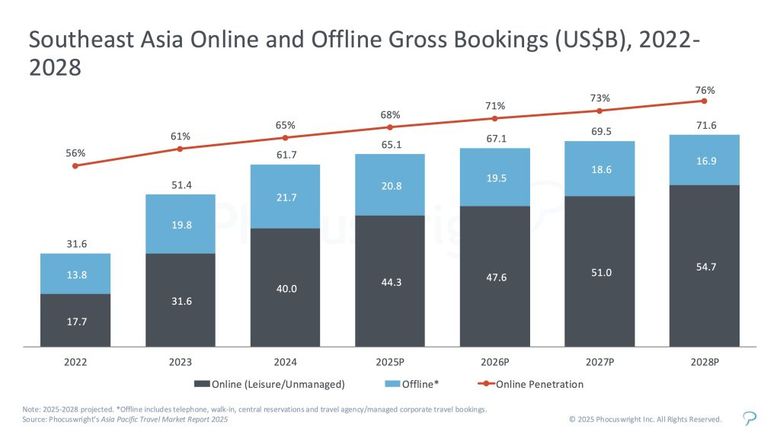
According to the e-Conomy SEA report by Google, Vietnam’s digital economy was valued at $39 billion in 2025 and is set to more than double to $80 billion by 2030. Online travel is expected to grow in tandem, doubling to $8 billion by 2030 from $4 billion in 2025.
That growth is drawing everyone into the online race. Legacy tour operators are modernizing at speed, international online travel agencies (OTAs) are consolidating their hold, domestic platforms specializing in niche mobility and national-led superapps are quietly taking shape in the background.
Traditional travel giants go digital-first
Vietnam’s long-established travel brands are no longer treating digital as a side project. For some, digital is now core to future survival.
Vietravel, founded in 1995 with 40+ domestic branches, operates across tour operations, air ticketing and transportation via WorldTrans and training through Vietravel Academy. The company is aiming to position digital tech as the backbone of its business, with a clear target to reach 70% of revenue generated via digital channels by 2030.
To get there, Vietravel plans to invest in a “robust Vietravel super app” to consolidate its ecosystem and compete as a leading OTA player.
Meanwhile, state-owned players are also adapting. Saigontourist, founded in 1975, spans a tour operator, more than 50 hotels and resorts, over 70 restaurants and the Saigon Exhibition & Convention Centre (SECC).
Hanoitourist, established in 1963, operates a tour business, 13 hotels and the Ho Tay (West Lake) Water Park. Its offerings are now integrated into the iHanoi super app, used by residents and visitors alike and include virtual reality (VR) and augmented reality (AR) night tours, ticketing and hotel bookings.
The digitally pragmatic traveler is also AI-ready
Vietnamese travelers are highly digital but not easily swayed by hype. A 2025 WiT-Social Seal study found that travelers gravitate towards vlogs, scenic tours, practical travel hacks and budget shopping strategies. They favor experience-driven and relatable storytelling, along with authentic, practical travel stories and detailed, bookmarkable guides that help with trip planning and shopping.
Artificial intelligence (AI), however, is an area where Vietnamese travelers stand out globally. The Global AI Sentiment Report by Booking.com showed that 99% of Vietnamese travelers use AI-powered search in their daily lives, while 95% use generative AI tools. Looking ahead, 99% want to use AI for future travel planning, and 58% expect autonomous trip planning to become mainstream soon.
The Google e-Conomy SEA report reinforces this enthusiasm, noting that Vietnamese users ranked first in AI engagement and trust. Yet there’s a contradiction worth watching. While apps with marketed AI features saw 78% revenue growth in the first half of 2025, this was the lowest number in the Association of Southeast Asian Nations (Indonesia recorded +127% growth). The report points to a say-do gap or potentially a significant untapped opportunity.
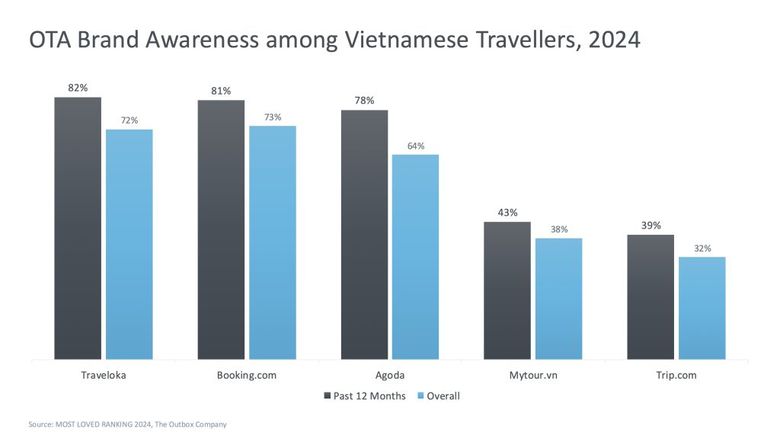
When it comes to expectations of travel technology, payment flexibility, translation and VR tech rank highest, according to Outbox.
AR and VR move from novelty to normal
Across Vietnam, AR and VR adoption at attractions is becoming normalized, especially at heritage sites.
At the Thang Long Imperial Citadel, AR overlays allow visitors to explore digital reconstructions of ancient structures in real-world spaces. The Van Mieu—Quoc Tu Giam (Temple of Literature complex) uses AR combined with AI in its “Vietnam Dieu Su” experience to recreate historical scenes within the heritage site itself.
Meanwhile, the Hue Monuments Conservation Centre’s “Finding the lost imperial palace” project uses Nreal Air AR glasses to immerse visitors in the Nguyen Dynasty, complete with court rituals, guard changes at the Ngo Mon Gate and performances at the Duyet Thi Royal Theatre, staged at their original locations.
OTAs go for international dominance, local specialization
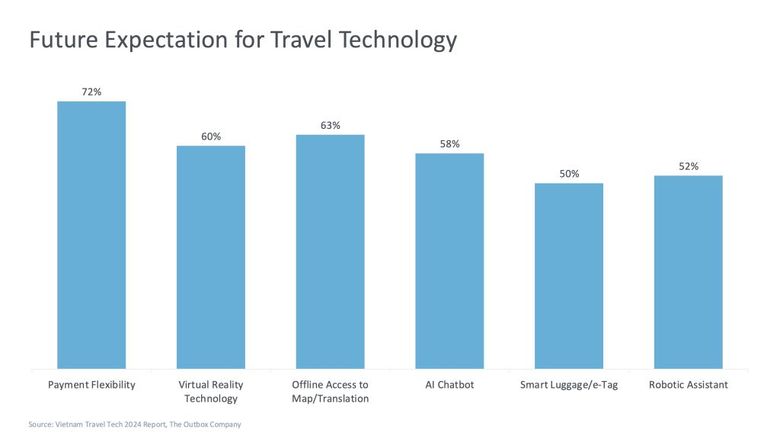
According to Outbox, Traveloka, Booking.com and Agoda are the most familiar OTA brands among Vietnamese travelers. A 2024 YouGov BrandIndex Consideration Score similarly ranked Traveloka, Booking.com and Agoda as the top OTAs.
KKday and Klook have both partnered with VinGroup and Sun Group to promote attractions and inbound travel to Vietnam. KKday stated that it would focus on Vietnam, aiming to drive $100 million for the Vietnamese tourism industry by 2023.
Platforms like VeXeRe, founded in 2013, have become leading players in bus and coach bookings, backed by investors including Woowa Brothers, Ncore Ventures, Access Ventures, Spiral Ventures and CyberAgent Ventures. Others, such as Vntrip, focus on hotel bookings with aggressive price matching, airport pickup bundles and strong B2B corporate travel solutions, supported by investors including IHAG Holding, Hendale Capital and FengHe Group.
There’s also Luxstay, often called the “Airbnb of Vietnam,” which targets homestays, villas and high-end apartments for a younger, tech-savvy demographic. Launched in 2016, it gained early attention by securing $6 million in investment on “Shark Tank Vietnam.”
The rise of travel-adjacent superapps
Beyond OTAs, travel-adjacent apps are quietly becoming powerful distribution layers.
Zalo, launched in 2012 by VNG Corporation, now operates as a full superapp with ZaloPay, government-linked Zalo Official Accounts, mini apps and integrations with hotel booking platforms, VeXeRe, and airlines such as Vietnam Airlines. It supports international QR payments and boasts 80 million monthly active users.
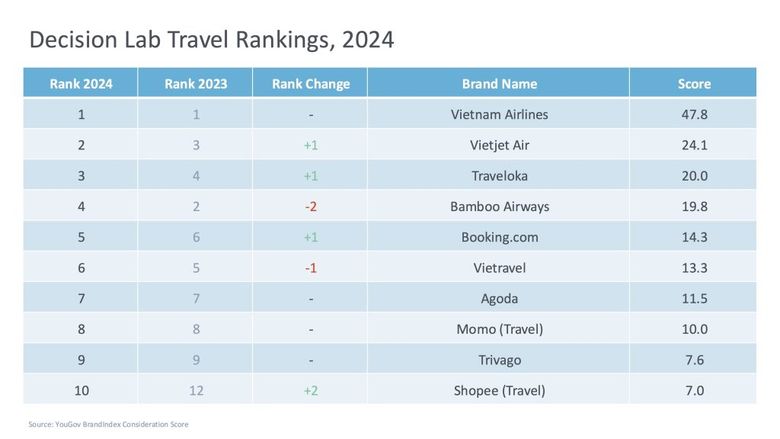
MoMo, Vietnam’s dominant e-wallet, has 34 million active users and around 70% of the e-wallet share. It operates a Travel & Transport mini app and ranked number eight in consideration for travel brands in the Decision Lab Travel Rankings 2024. Vietnamese banks such as BIDV are also embedding flight and bus booking modules directly into their banking apps.
A national “superapp”
A national-led superapp, the “Visit Vietnam” app, developed by Sun Group and supported by Visa, is set to launch in 2026. The app aims to link tourism data with consumer products, incorporating big data from across the tourism ecosystem, including a real-time tourism data map to help destinations and businesses manage visitor flows.
On the consumer side, it will allow tourists to create personalized itineraries, book services and receive alerts about weather and crowding, outlining a future where national tourism strategy and consumer experience sit on the same platform.
This article originally appeared on WiT.
The Online Travel Tracker series from WiT
The Online Travel Tracker is a brand-new monthly report focusing on various subjects shaping the travel tech landscape in the region. This article is based on data from the Online Travel Tracker Volume 1: Vietnam Revealed.
link