
Property market to remain stable, backed by prime office, industrial and tourism-related sectors
This article first appeared in City & Country, The Edge Malaysia Weekly on January 19, 2026 – January 25, 2026
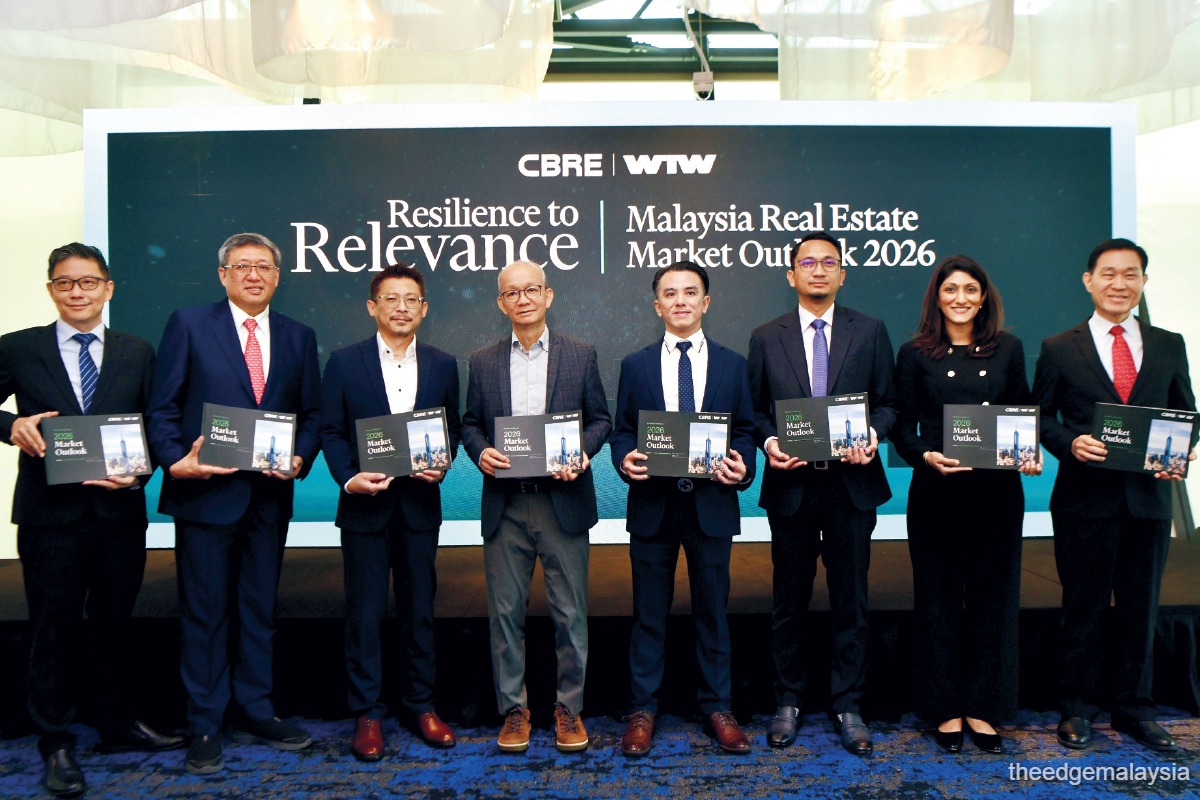
Malaysia’s property market is expected to maintain its stable growth trajectory this year, primarily driven by the prime office, industrial and tourism-related sectors, as well as the ongoing catalytic infrastructure projects, according to the CBRE | WTW Market Outlook Report 2026 titled “Resilience to Relevance”.
“Across Malaysia, there are several themes as we look at 2026, including a greater emphasis on asset quality and adaptability, the continued influence of infrastructure and connectivity, rising expectations around sustainability and efficiency, and more value-driven decision-making by occupiers and investors. In certain locations, given the current situation and pipeline of infrastructure projects, we believe property prices will continue improving at a reasonable rate,” said group managing director Tan Ka Leong at the launch of the report on Jan 7.
The report focuses on the outlook for key areas in Malaysia, including the Klang Valley, Penang, Iskandar Malaysia, Kota Kinabalu and Kuching, as well as emerging hotspots such as Seremban, Nilai, Ipoh and Kuantan.
Ka Leong said well-priced and well-managed residential properties, whether landed or high-rise, are expected to remain in demand. Price increases are anticipated to be moderate, likely exceeding 3%.
He also acknowledged that over the years, developers have factored in a lot of future considerations when setting the prices of their properties.
“Many projects had prices based on the gross amount but the developers actually offered significant discounts — some were more than 15%. So, the question of whether there has been true appreciation depends on whether you benchmark the gross or net price,” he said.
“Banks approve loans based on the SPA (sale and purchase agreement) price, not the discounted price. They are aware of the potential consequences. Some projects, once completed, soon offer options that affect pricing. Banks, including Bank Negara Malaysia, are aware of the seriousness of this issue. They are taking action and exercising caution, especially since some banks have suffered losses.”
This initiative will ease home loan approvals, he added.
Klang Valley: Repositioning, repurposing
According to the report, the industrial property sector will remain a focal point of the Klang Valley’s real estate market, supported by demand from the logistics, e-commerce and light manufacturing segments, as well as technology-driven ones such as electrical and electronics (E&E), semiconductors and data centres. About 9.45 million sq ft of new net lettable area is expected to come on stream this year.
This supply is targeted at evolving occupier needs, particularly third-party logistics service providers and e-commerce operators seeking scalable and strategically located facilities. While the influx may temporarily moderate occupancy and rental rates, demand is anticipated to absorb the space over time.
Adaptive reuse of older and underutilised industrial assets is gaining traction as higher land values, improving connectivity and changing operational requirements make redevelopment increasingly viable.
In the office sector, sustainability and asset quality are emerging as key differentiators. Ageing purpose-built offices (PBOs) are being enhanced with green features, with about 96% of new completions expected to be certified green. Older non-prime offices, however, continue to lose relevance.
“Overall [average] office occupancy in the Klang Valley stands at 79.2%, with prime offices improving, while non-prime demand falls,” said CBRE | WTW director of research and consulting Mary Kurien.
More than five million sq ft of prime office space is due for completion by 2028, likely intensifying pressure on secondary stock. In response, office-to-hotel and office-to-residential conversions are increasing, supported by Budget 2026 tax incentives encouraging commercial repurposing.
Residential demand is anticipated to remain highly selective and price-conscious, shaped by affordability, sustainability considerations and long-term capital appreciation. The report notes that closer alignment between connectivity, employment nodes and residential planning will be critical, particularly in emerging corridors benefiting from new infrastructure.
In the hotel sector, CBRE | WTW expects a luxury-weighted pipeline, with close to 90% of new rooms in the five-star category reflecting higher-value travel linked to Visit Malaysia 2026. Mid-tier hotels, especially in Selangor, are also seeing stronger momentum.
“The hotel market outlook remains positive, with tourist arrivals expected to increase by 50% this year, alongside continued interest in converting prime office buildings into hotels,” said Kurien.

Penang: Industrial connectivity
Penang’s industrial property sector continues to attract strong investment, particularly from companies in advanced manufacturing and technology-related industries.
Approved manufacturing investments totalled RM15.59 billion across 146 projects from January to September 2025 (9M2025), up from RM12.14 billion in 9M2024. While growth is expected to be modest amid global economic uncertainties, fundamentals remain resilient, underpinned by E&E, medical devices and logistics.
During this period, foreign investments accounted for 78% of the approvals, while domestic investments made up 22%, said CBRE | WTW director Tan Chean Hwa. Notable projects included Hotayi Electronic, which invested RM500 million in a manufacturing facility in Batu Kawan.
“New private industrial parks are emerging such as Nexus Industrial Hub and M12 Industrial Park @ Bukit Minyak, mainly comprising two-storey semi-detached units,” he added. Major industrial developments in the pipeline include Bandar Cassia Technology Park, Batu Kawan Industrial Park, Penang Science Park South, Penang Technology Park and Northern Tech Valley.
Large-scale initiatives continue to reinforce Penang’s long-term positioning in the industrial property sector. The 2,300-acre Penang Silicon Island had achieved a reclamation rate of 11% as at October 2025.
Penang’s strengths lie in E&E and medical manufacturing, with logistics also gaining momentum. Infrastructure projects such as the Penang LRT Mutiara Line and the Penang International Airport (PIA) expansion are expected to complement upcoming industrial growth and strengthen connectivity across the state.
Tourism is projected to boost the retail and hospitality sectors, supported by anticipated growth in mid to upscale hotels. Ongoing infrastructure projects such as the PIA expansion, MICE (meetings, incentives, conferences and exhibitions)-driven developments, the Penang Hill Cable Car and the Penang Waterfront Convention Centre are expected to sustain visitor demand.
Penang’s retail performance is forecast to remain steady but segmented, with future growth concentrated in integrated developments near residential and commercial hubs. Total retail stock in Penang stands at about 21.1 million sq ft — 12.02 million sq ft on Penang Island and 9.08 million sq ft in Seberang Perai.
Corporate expansions continue to support the PBO market, with demand led by multinational corporations such as Advanced Micro Devices and Coherent Corp. The office market expects measured growth, driven by prime developments and occupier preference for well-located, purpose-built assets, although rental growth is likely to remain selective.
Iskandar Malaysia: Investments abound
Iskandar Malaysia will see a sustained growth cycle, anchored in the spillover from Singapore, improved connectivity and institutional investments. The industrial property sector sees expansion driven by foreign investments and manufacturing diversification.
Fundamentals remain healthy, with supply rising, vacancies declining and demand shifting towards managed industrial parks offering enhanced facilities, security and greener features. “We are witnessing dual-speed evolution — steady growth in traditional logistics alongside a surge in the data centre segment,” said CBRE | WTW director Jonathan Lo.
“Johor recorded RM91.1 billion in approved investments in 3Q2025, surpassing Selangor’s RM52 billion and Kuala Lumpur’s at RM46 billion. Total approvals are projected to grow further.” Lo based this trajectory on the 106% year-on-year increase of approvals from 2024 to 2025, supported by foreign and domestic investments.
Average transaction value rose from RM4.7 million in 3Q2024 to RM7 million in 3Q2025, reflecting greater buyer selectivity for strategic assets. Contributing factors include rising costs in Singapore, facilitation of the Johor-Singapore Special Economic Zone (JS-SEZ) and alignment with shifts in the global supply chain.
Data centres remain a key growth segment, supported by the proximity to Singapore and shifting demand to secondary zones with more accessible land. While approvals for Tier 1 and 2 data centres have slowed, Johor is strengthening its power and water capacity to support technology-based facilities, according to Lo.
Office markets are expected to remain stable, with occupiers favouring Grade A offices in prime locations. Co-working spaces are expanding, linked to cross-border activity via the JS-SEZ and the Johor Bahru-Singapore Rapid Transit System (RTS) Link.
The delivery of residential properties is expected to be a manageable entry of 2,300 units in 2026, before a foreseeable surge to over 9,000 units between 2027 and 2029, potentially putting absorption under pressure. Infrastructure projects such as the Gemas-Johor Bahru Electrified Double Track Project, RTS Link and JS-SEZ, as well as upgraded bus networks and Visit Johor 2026, are expected to support demand across the sectors.

Kota Kinabalu: Hospitality taking the lead
Presenting the property market outlook for Kota Kinabalu, C H Williams Talhar & Wong (Sabah) Sdn Bhd managing director Cornelius Koh said the hospitality sector will be the key driver this year.
“We have not exactly gone up to the peak of the curve yet, which was where we were just before the pandemic, when total arrivals were about 4.2 million. We have only arrived at about 3.5 million. So, we need to have a little bit of growth to actually hit 4.2 million,” he added.
“The [arrivals from] mainland China have more or less reached pre-pandemic levels, which is good, but those from South Korea, there has been some reduction. But I think the projection is still looking good.”
Koh said the target for Kota Kinabalu’s tourism numbers is four million this year. However, he cautioned that Sabah could expect more competition from the other states offering more or new tourism products.
Although the arrivals have been improving, one would assume that the hotel industry is also improving across the board. But that has not been the case, said Koh.
“We can see that the five-star category improved marginally and the three-star also improved. But there is a little bit of concern about the four-star category. Because in Kota Kinabalu, we have had a sudden surge in Airbnb units, commercial suites and short-term accommodation.”
He said industrial activity in Kota Kinabalu, Penampang and Putatan is supported by developments such as The Gallery Industrial Estate in Inanam and Armani Business Park in Sepanggar. Industrial properties with good infrastructure remain in demand, given the limited new supply. He added that the transaction volume had increased, although transaction values had shown moderate fluctuation, reflecting sustained investor confidence and strategic positioning.
Sarawak: Industrial and residential property boom
Presenting the property market outlook for Sarawak, C H Williams Talhar & Yeo Sdn Bhd managing director Robert Ting Kang Sung said the state is seeing a shift from traditional drivers to a new economic vision fuelled by infrastructure, renewable energy and ongoing high-value industries.
“Sarawak will be the fastest-growing engine in the industrial property sector. The state’s renewable energy capability and abundant land resources are powering industry and attracting investors,” he added.
Ting said the demand for semi-logistics and manufacturing space has increased, particularly in the hydrogen, aerospace and renewable energy sectors. “This is not a temporary boom, it represents a long-term industrial transformation.”
The current strength of Sarawak’s industrial property sector is supported by the initiatives of the state government, which has 40 million sq ft of industrial assets across its jurisdiction.
Development is spreading beyond Kuching and Bintulu to all parts of Sarawak. An additional 58.2 million sq ft of industrial plants are in the pipeline, including expansions in Sama Jaya and Kuching.
However, challenges remain. Ting pointed out that Sarawak had traditionally focused on palm oil and oil and gas.
“The government is now shifting its attention to high-tech and green technology sectors to ensure long-term sustainability. Opportunities are emerging as the government develops greenfield projects in the high-tech and logistics industries,” he said.
Residential property activity in Kuching remains resilient, particularly in the mid-market segment. Ting said the sector is expected to remain stable and moderately positive moving forward.
“Challenges remain, including rising construction costs and high-rise oversupply. However, landed housing is expected to continue delivering the market’s most reliable performance.”
The residential property sector is expected to benefit from the state government’s initiatives such as the Sarawak Affordable Housing Trust Fund channel developer contributions to support affordable housing. Meanwhile, the Housing Deposit Assistance Scheme provides RM10,000 towards deposits for first-time homebuyers in the B40 segment and the ongoing rental subsidy under the Housing Development Corporation continues to support first-time and mid-term buyers.
Emerging areas
The report says Seremban and Nilai in Negeri Sembilan are expected to evolve from resilient suburban markets into key extensions of the Greater Klang Valley. Residential property demand will be driven by affordability, liveability and improved connectivity, with homeowners favouring sustainable designs, practical layouts and township-led amenities.
On the industrial property side, Malaysia Vision Valley 2.0 remains a major catalyst, attracting high-value and ESG-focused occupiers. Demand for industrial parcels is set to rise, supporting price growth, although absorption will vary by location and project readiness. The Enstek-Nilai belt is emerging as the corridor’s operational core, supported by state government initiatives, better connectivity and a growing advanced manufacturing and green industrial ecosystem.
Perak’s tourism sector is growing steadily, with 27.4 million domestic arrivals in 2Q2025 (+4.2% year on year) and 406,929 foreign hotel guests in 1H2025 (+2.5%), mainly from Singapore, Thailand, China and Indonesia. Visa-free access for tourists from China and India is expected to further boost arrivals.
Upgrades to the Sultan Azlan ShahAirport in Ipoh, Perak increased capacity by 40% and the introduction of Batik Air’s new direct flight from Singapore to Ipoh, commenced in December 2025, is expected to increase tourist arrivals, particularly from Indonesia and neighbouring countries, says the report. Key infrastructure projects include Ipoh Sentral, a 67-acre transit-oriented development, and the West Coast Expressway, while medical tourism is expanding with Sunway Medical Centre Ipoh.
Meanwhile, Kuantan, Pahang, is entering a new industrial growth phase as improved connectivity and an expanding ecosystem translate into real activity. The East Coast Rail Link and Kuantan Port upgrades will enhance supply chain efficiency, making the Gebeng and Malaysia-China Kuantan Industrial Park corridor increasingly attractive to high-value and export-oriented industries.
Save by subscribing to us for
your print and/or
digital copy.
P/S: The Edge is also available on
Apple’s App Store and
Android’s Google Play.
link