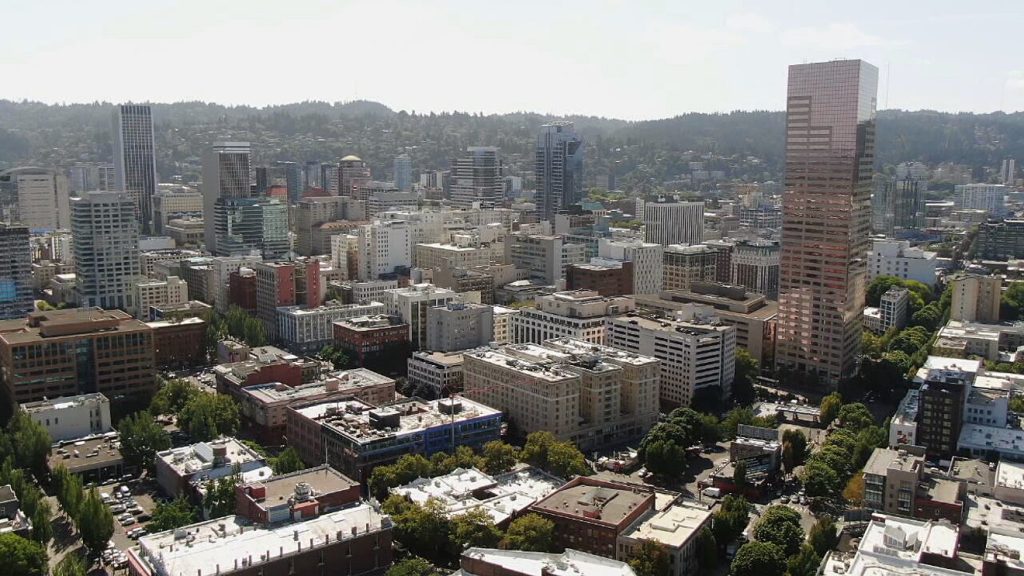
Portland’s 20 largest office buildings have lost $2 Billion in market value since 2019
PORTLAND, Ore. (KATU) — As governments across the state prepare for budget season in the next few months, local governments in Multnomah County continue to deal with a commercial real estate market in freefall.
The reality seemed unimaginable before the pandemic: Portland’s 20 largest office buildings have lost nearly 70% of their market value since 2019.
KATU obtained records from Multnomah County that show the properties had a combined market value of $3 billion in 2019, compared to $986 million today.
“It is shocking. I think again, without the pandemic, I’m not sure we would have thought these types of adjustments were even really possible,” county economist Jeff Renfro said.
The market reset is one reason for the budget cuts across local governments. The assessed values of the same 20 properties, the amount the county taxes on, dropped from a combined $1.2 billion in 2019 to $890 million today.
It’s costing local governments millions of dollars in foregone property tax revenue.
Fox Tower, Montgomery Park, Standard Insurance, and PacWest lost a combined $170 million in taxable value since 2019.
READ MORE | Portland leaders under pressure to re-imagine downtown as property values plummet
“Last year, when we were putting our budget together, one of our primary problems is that we were only seeing property tax growth of $8 million a year, every year, and typically we would see something like $20 million year over year property tax revenue growth,” Renfro said.
Portland’s budget is seeing the same hit. In 2025, the city said it expected $67 million in budget cuts this summer.
The values are going down, in part, due to appeals from property owners. Records KATU obtained from the county assessor’s office show industrial, multifamily, and commercial (INCOM) property owners are fighting their tax bills more frequently than in the past.
In the 2023 tax year, 313 property owners appealed their values in the initial appeal process. That number jumped to 422 in 2024 and to 529 in the current tax year. The number will go higher as the appeals process plays out and could exceed 1,000.
The appeals can take years to settle and often result in refunds to property owners. The county assessor’s data showed appeals cost local governments in Multnomah County more than $30 million in 2023 and 2024 combined.
For context, Washington County saw a quarter as many appeals as Multnomah County did in 2024, the most recent year available. It lost less than $1 million in tax revenue from appeals that year.
Clackamas County shared records showing the assessor’s office received 116 INCOM appeals in 2024 and 108 in 2025. The county refunded roughly $2.2 million due to the appeals in 2023 and 2024.
Renfro doesn’t expect a quick turnaround.
“We’d originally assumed that fiscal year 2026, the current year, would be the bottom for that decline in downtown office values. Based on some of the recent market transactions we’ve seen, like the sale of Big Pink and PacWest, we updated our assumption to assume we’d see another year of declines in fiscal year 2027,” Renfro said.
The math for local governments is pretty simple.
We’ve had several years of inflation that pushed costs up; at the same time, the revenue growth from taxes slowed. Generally, counties could see property tax revenue growth between 4% and 5% a year. However, economists told KATU it’s been closer to 1.5% in the last couple of years in Multnomah County.
The crunch from property taxes is one reason for repeated budget gaps in local school districts and governments, along with increased costs associated with healthcare and the Public Employee Retirement System, or PERS.
Earlier this year, Portland leaders said they expected a $67 budget gap this summer. Portland Public Schools anticipates a $50 million gap.
Many governments point the finger at the state’s property tax laws. Voters approved Measures 5 and 50 in the 1990’s.
Put simply, Measure 5 limits your tax bill based on the market value of your property; Measure 50 caps assessed value growth at 3% a year in nearly all circumstances. This effectively means local governments’ tax revenue grows 3% a year, plus any new tax revenue from new development.
Critics of the laws said the limits put local governments in a tough spot financially. KATU highlighted an effort to start the discussion about overhauling the state’s property tax system during the 2025 legislative session.
The League of Oregon Cities was a big part of that effort.
READ MORE | Facing multi-million-dollar shortfalls, local governments set eyes on OR property tax laws
“Our biggest thing is getting the legislature to help us convene the necessary people to start talking about: what is the new property tax system that replaces the one that we currently have that is actually adequate, that’s fair, that’s equitable for local governments and for community members alike,” Jenna Jones told KATU last year.
Any effort to change the system would require input from voters, because the laws are in the state constitution. Bill Sizemore, an anti-tax advocate, authored Measure 50 and said he’d oppose any effort to change it.
“Before you go to the taxpayers and say, ‘hey, you need to pony up more money because we can’t afford our budgets,’ look at the interior of your own budgets and say, ‘where are we really spending money that we really can’t afford,’” Sizemore told KATU.
Absent changes, Portland city leaders could be faced with more years of tough budget decisions. Renfro said the county is anticipating that reality.
“We’re not anticipating any significant turnaround in these values or any associated increase in our property tax revenue in our five-year forecast.”
Editor’s note: This story was updated to reflect Clackamas County data.
link