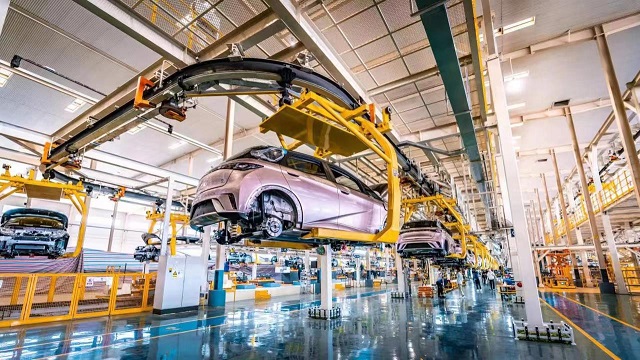
Auto manufacturers from around the world are moving in to grab a bigger piece of the Canadian marketplace as a trade war with the United States drags on.
Vehicles made outside North America accounted for 34 per cent of Canadian monthly vehicle sales in August, the latest data available from Statistics Canada, up from 28.8 per cent in March, the month before the U.S. introduced tariffs on foreign vehicles.
Overall, the share of vehicles made in Canada, the U.S. and Mexico that were sold in the Canadian marketplace declined during the same period to 65.9 per cent from 71.1 per cent.
Investment in auto manufacturing has long been flowing out of both Canada and the U.S., which is the reason U.S. President Donald Trump gave for imposing tariffs on foreign-made vehicles and parts.
Between 2014 and 2024, Mexico’s share of Canadian vehicle imports grew to 16.7 per cent from 14.01 per cent, while South Korea’s share grew to 10.2 per cent from 5.86 per cent, according to Ministry of Industry data. Japan and China also increased their shares of the marketplace, but Germany’s and the United Kingdom’s shares declined.
In the same time period, U.S. vehicle exports to Canada declined to 48.9 per cent of the market from 60.8 per cent.
The migration of manufacturing to countries with lower labour costs and oftentimes lower environmental and safety standards ties into a long-term contraction of Canadian vehicle manufacturing.
In 2024, vehicle production in Canada hit 1.24 million vehicles, down 58 per cent from its 1999 peak of 3.1 million vehicles. Now, things look set to worsen more as the U.S. and Canada — both each other’s largest export market — engage in a protracted trade battle.
“It’s a great opportunity for companies in other parts of the world to just kind of step up and be like, ‘Well, we can sell you cars,’” Brendan Sweeney, managing director of the Trillium Network for Advanced Manufacturing in London, Ont., said.
That’s in part because as the U.S. and Canada have erected tariff regimes that affect each country’s duty rate on finished vehicles and auto parts, other countries’ auto sectors remain safely above the fray and are able to import vehicles here on a duty-free basis.
Sweeney said the 50 per cent U.S. tariffs on Canadian steel and aluminum, both key inputs in auto manufacturing, have further escalated costs.
Canada is the largest export market for U.S.-made vehicles, with the U.S. shipping US$23.2-billion worth of vehicles here in 2024. That’s more than the U.S.’s next seven largest export markets — Germany, Mexico, China, United Arab Emirates, South Korea, Saudi Arabia and Belgium — combined, according to the International Trade Administration.
Stephen Beatty, a former Toyota Canada executive, has said that the current policy landscape encourages automakers to ship from manufacturing operations outside North America, particularly if they have a free-trade agreement with Canada.
“Whatever the U.S. thinks it’s doing, the problem is they’re giving up the one good export market they’ve got,” he said. “It’s a perverse impact of U.S. policy. They think they’re protecting the U.S. market, but the U.S. market continues to decline.”
The problem for Canadian automakers is that their biggest export market — the U.S., where they sent 88 per cent of their vehicles in 2024 — is also expected to shrink in the face of trade barriers.
Already this year, Stellantis NV has indefinitely halted a $1 billion investment in its assembly plant in Brampton, Ont., and General Motors Co. announced plans to cut a shift from its assembly plant in Oshawa, Ont., in 2026. GM also ended production of its BrightDrop electric delivery van in Ingersoll, Ont.
Taken together, the two automakers’ moves have exacerbated fears that the migration of auto investment out of Canada is accelerating.
“We are in big trouble,” Fen Hampson, a professor of international affairs at Carleton University in Ottawa, said. “We need to start asking the question, ‘Where are the jobs going to be a year from now?’”
Unifor, which represents 320,000 workers in Canada, including many in the auto sector, has called on the federal government to step up restrictions on trade with the U.S., including restrictions on exports of energy, potash and aluminum. (Full disclosure: the Financial Post newsroom is organized under Unifor).
“If we allow these corporations to shift production to the United States without applying equal pressure to keep these jobs in Canada, they can and will do so,” Lana Payne, president of Unifor, testified in October at Parliament’s Standing Committee on International Affairs.
She said Canada should be prepared to reject the renewal of the Canada-U.S.-Mexico Agreement (CUSMA) when it comes up for review next year, if necessary, to secure a deal that protects Canadian industry, acknowledging that it would be a “bold” move.
In recent weeks, there have been a series of meetings involving federal government and provincial officials, labour leaders, auto analysts and executives.
In comments submitted to the U.S. Trade Representative in advance of next year’s review of CUSMA, the automakers with operations in Canada called for a preservation of the “trilateral approach,” a return to the idea of an integrated North American auto market that allows vehicles and parts to flow freely between the three countries.
“Given the importance of both Canada and Mexico in supporting Toyota’s U.S. manufacturing base, it is crucial that (CUSMA) continues to allow duty-free cross-border trade for automobiles and auto parts,” a Toyota Motor Co. representative told the U.S. Trade Representative last month.
Stellantis said a 15 per cent duty rate on automakers in foreign countries, naming South Korea in particular, would be too low.
“Auto production in Asia, particularly in South Korea, is already competitive even with high tariffs,” the automaker said in a letter to the trade representative.
Beatty said that he believes many automakers have been eating the costs of tariffs and are still adjusting their supply chains and the mix of vehicles they sell to lower their costs.
“The world of trade going forward is going to look far more restrictive than it has in the past couple of decades,” he said.
• Email: [email protected]