Decarbonization Market 2025: Cloud-Based Solutions Lead with
Decarbonization Market
Leander, Texas, United States – Nov.20.2025
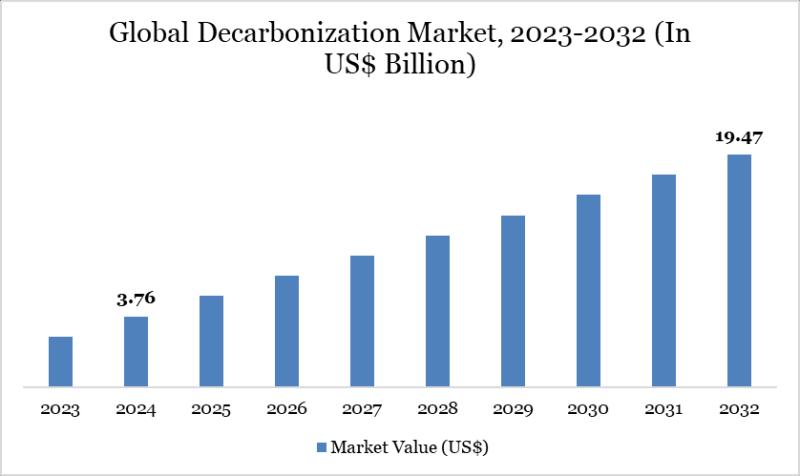
As per DataM intelligence research report” Global Decarbonization Market reached US$ 3.76 billion in 2024 and is expected to reach US$ 19.47 billion by 2032, growing with a CAGR of 22.82% during the forecast period 2025-2032.”. Global climate goals and corporate sustainability mandates are driving rapid decarbonization across heavy industries.
Download your exclusive sample report today: (corporate email gets priority access): https://www.datamintelligence.com/download-sample/decarbonization-market?sp
United States: Recent Industry Developments
✅ In November 2025, ExxonMobil launched a large-scale industrial decarbonization initiative integrating hydrogen, CCS, and low-carbon fuels for petrochemical plants along the Gulf Coast. The program targets multi-million-ton annual CO2 reductions. This reinforces ExxonMobil’s leadership in U.S. industrial decarbonization.
✅ In October 2025, Amazon invested US$200 million to expand renewable energy installations, fleet electrification, and data center efficiency upgrades under its Climate Pledge roadmap. The effort accelerates emission reductions across logistics and cloud operations. This strengthens Amazon’s position in corporate decarbonization leadership.
✅ In September 2025, Duke Energy deployed advanced grid decarbonization systems combining battery storage, smart-load management, and renewable integration across southeastern states. The upgrades enhance grid reliability and emissions performance. This development highlights Duke Energy’s role in U.S. clean energy transition.
✅ In August 2025, Ford Motor Company implemented low-carbon manufacturing systems at key U.S. plants, integrating renewable-powered production lines and recycled-material components. The initiative reduces lifecycle emissions for EV and ICE models. This reinforces Ford’s commitment to sustainable automotive manufacturing.
Japan: Recent Industry Developments
✅ In November 2025, Toyota Motor Corporation introduced a new decarbonization program integrating hydrogen engines and renewable-powered manufacturing across domestic plants. The initiative drives reductions in both vehicle and production emissions. This solidifies Toyota’s leadership in Japan’s mobility decarbonization.
✅ In October 2025, Mitsubishi Corporation invested ¥20 billion in green hydrogen production and supply-chain infrastructure to support industrial decarbonization. The investment accelerates Japan’s shift toward low-carbon fuels. This reinforces Mitsubishi Corporation’s position in Japan’s clean energy transition.
✅ In September 2025, Hitachi expanded deployment of industrial decarbonization platforms integrating energy analytics, smart grids, and carbon tracking for manufacturing clients. The solutions improve efficiency and emission transparency. This highlights Hitachi’s growing influence in Japan’s industrial sustainability market.
✅ In August 2025, ENEOS advanced low-carbon refinery operations using renewable steam, carbon capture pilots, and biofuel processing upgrades. The projects help reduce emissions across Japan’s energy supply chain. This strengthens ENEOS’s commitment to long-term decarbonization initiatives.
Decarbonization Market: Drivers
The decarbonization market is gaining strong momentum as countries, industries, and corporations intensify efforts to reduce greenhouse gas emissions and transition toward sustainable, low-carbon economies. Decarbonization strategies encompass renewable energy adoption, electrification, energy efficiency improvements, circular economy practices, and carbon capture technologies. Rising global commitments to net-zero targets, coupled with stricter climate policies and environmental regulations, are accelerating deployment across energy, transportation, manufacturing, and construction sectors. Rapid advancements in clean energy technologies such as solar, wind, green hydrogen, and energy storage are further enabling cost-effective carbon reduction pathways. Additionally, increasing investor focus on ESG performance is driving large-scale funding for climate-positive infrastructure and innovation.
Collaboration among governments, technology providers, and industrial players is catalyzing the development of integrated decarbonization solutions across value chains. Digital technologies, including AI, IoT, and advanced analytics, are improving energy optimization, emissions monitoring, and predictive maintenance across industrial operations. Growing adoption of electric mobility, low-carbon fuels, and sustainable materials is reshaping traditional industries and supply chains. Corporate sustainability commitments and green financing mechanisms are further accelerating the shift toward carbon-neutral operations. With rising climate urgency, expanding clean energy capacity, and continuous technological innovation, the global decarbonization market is set for sustained and transformative growth.
Get Customization in the report as per your requirements:
https://www.datamintelligence.com/customize/decarbonization-market?sp
Decarbonization Market: Emergingg Players
Climeworks
Climeworks is advancing large-scale direct air capture technology designed to remove CO2 directly from the atmosphere for permanent underground storage. Their modular plants are rapidly scaling across Europe and North America, supported by strong corporate demand for carbon removal. With growing investment and expanding capacity, they are shaping the future of engineered decarbonization solutions.
Twelve
Twelve is an electrofuels innovator that uses carbon transformation technology to convert captured CO2 into chemicals, materials, and sustainable aviation fuels. Their process replaces fossil feedstocks in hard-to-abate sectors, helping decarbonize aviation, chemicals, and plastics. As commercial partnerships expand, Twelve is becoming a prominent player in circular carbon applications.
Sustaera
Sustaera is developing modular, renewable-powered direct air capture systems that use ceramic sorbents to capture CO2 at lower cost. Their units are designed for rapid deployment and scalability, supporting gigaton-level removal goals. Backed by significant climate-tech investments, Sustaera is emerging as a key competitor in low-cost carbon capture.
Verdox
Verdox has created an electro-swing adsorption technology that captures CO2 using electricity instead of heat, reducing energy consumption dramatically. This design enables flexible, intermittent operation that pairs well with renewable energy. Their highly efficient capture mechanism positions the company as a next-generation decarbonization technology leader.
LanzaTech
LanzaTech converts industrial emissions into valuable fuels and chemicals using a unique gas-fermentation platform powered by microbes. Their technology transforms waste carbon streams into useful products, enabling circularity for steel, refining, and industrial sectors. With global industrial partnerships, LanzaTech is rapidly scaling its decarbonization impact across multiple value chains.
Segment Covered in the Decarbonization Market:
By Technology
Carbon Capture, Utilization & Storage (CCUS) leads with 32-34% share, driven by large-scale industrial and power-sector decarbonization. Renewable energy solutions follow closely at 28-30%, supported by solar, wind, and green hydrogen expansion. Energy efficiency & electrification holds 22-24%, boosted by industrial retrofits and electric fleets. Alternative fuels account for 12-14%, driven by SAF, biofuels, and ammonia adoption, while others hold 4-6%.
By Deployment
Cloud-based decarbonization platforms dominate with 56-58%, driven by scalable analytics, carbon accounting, and remote reporting tools. On-premises solutions hold 42-44%, primarily used by heavy industries and regulated sectors requiring secure, integrated emission-control systems for real-time facility operations.
By Transportation Mode
Road transport leads with 40-42% share as EV fleets, biofuel adoption, and carbon-tracking platforms scale globally. Aviation holds 28-30%, driven by SAF demand, carbon offsets, and emission-monitoring systems. Sea transport accounts for 18-20%, with rising use of green ammonia, methanol, and efficiency tools. Rail transport captures 10-12%, supported by electrification and low-emission freight initiatives.
By End-User
Energy & power leads with 33-35%, driven by renewable integration, grid modernization, and CCS deployment. Industrial manufacturing & heavy industries hold 27-29%, as cement, steel, and chemicals accelerate decarbonization. Oil & gas contributes 16-18%, adopting CCUS and methane reduction tools. Transportation & logistics hold 12-14%, while buildings, construction, agriculture, and others collectively account for 10-12%.
Regional Analysis
North America – 33-35% Share
North America leads with major investments in renewable energy, CCUS hubs, electric mobility, and carbon accounting platforms. Strong regulatory policies in the U.S. and Canada accelerate industrial decarbonization. AI-driven emission tracking and clean hydrogen projects strengthen adoption. Corporate sustainability commitments further drive market growth.
Europe – 29-31% Share
Europe follows with stringent climate laws, carbon pricing mechanisms, and rapid electrification across transport and buildings. Germany, the U.K., and Nordic nations lead in green hydrogen, renewables, and industrial decarbonization. The EU’s Fit-for-55 and Net-Zero Industry Act drive strong demand for digital and operational decarbonization solutions.
Asia-Pacific – 25-27% Share
Asia-Pacific grows fastest as China, India, Japan, and South Korea accelerate renewable integration, EV deployment, and industrial emission reduction. Heavy industries adopt CCUS and energy-efficiency upgrades. Government net-zero targets and large infrastructure investments strengthen the region’s decarbonization roadmap. Digital carbon platforms gain major traction.
Middle East & Africa – 5-6% Share
MEA expands through national decarbonization strategies focused on blue/green hydrogen, CCUS, and low-carbon industrial clusters. The UAE, Saudi Arabia, and South Africa lead adoption, supported by world-scale renewable and clean-fuel projects. Energy-intensive industries drive strong early-stage opportunities.
South America – 4-5% Share
South America grows steadily with Brazil, Chile, and Argentina strengthening renewable energy portfolios. Biofuels, green hydrogen, and carbon farming gain momentum. Industrial emitters adopt early-stage carbon management tools. Supportive policies and export-driven sustainability commitments help broaden adoption.
Purchase this report before year-end and unlock an exclusive 30% discount:
https://www.datamintelligence.com/buy-now-page?report=decarbonization-market
(Purchase 2 or more Repots and get 50% Discount)
Request for 2 Days FREE Trial Access:
https://www.datamintelligence.com/reports-subscription?sp
✅ Competitive Landscape
✅ Technology Roadmap Analysis
✅ Sustainability Impact Analysis
✅ KOL / Stakeholder Insights
✅ Consumer Behavior & Demand Analysis
✅ Import-Export Data Monitoring
✅ Live Market & Pricing Trends
Have a look at our Subscription Dashboard:
https://www.youtube.com/watch?v=x5oEiqEqTWg
Contact Us –
Company Name: DataM Intelligence
Contact Person: Sai Kiran
Email: [email protected]
Phone: +1 877 441 4866
Website: https://www.datamintelligence.com
About Us –
DataM Intelligence is a Market Research and Consulting firm that provides end-to-end business solutions to organizations from Research to Consulting. We, at DataM Intelligence, leverage our top trademark trends, insights and developments to emancipate swift and astute solutions to clients like you. We encompass a multitude of syndicate reports and customized reports with a robust methodology.
Our research database features countless statistics and in-depth analyses across a wide range of 6300+ reports in 40+ domains creating business solutions for more than 200+ companies across 50+ countries; catering to the key business research needs that influence the growth trajectory of our vast clientele.
This release was published on openPR.
link