


Brazil Heritage Tourism Market Summary
The Brazil heritage tourism market size was estimated at USD 15.78 billion in 2024 and is expected to reach USD 20.36 billion by 2033, growing at a CAGR of 3.0% from 2025 to 2033. The industry is rich and diverse, drawing visitors to its colonial architecture, Afro-Brazilian cultural sites, and indigenous heritage. Key destinations such as Salvador, Ouro Preto, and Paraty offer immersive historical experiences. Government and UNESCO-backed preservation efforts support tourism growth, while cultural festivals further attract international interest. The market is expanding as travelers seek authentic, culturally rooted experiences.
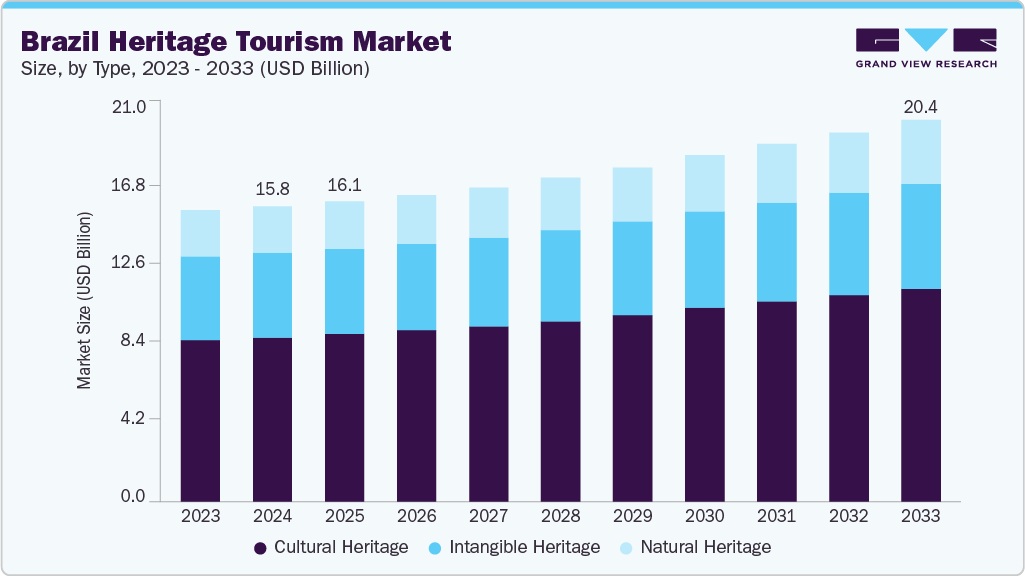

The market thrives on its blend of Portuguese, African, and indigenous influences showcased through historical towns, music, cuisine, and art. Cities such as Recife and São Luís offer unique narratives through well-preserved landmarks and cultural traditions. Increasing investment in heritage conservation and community-based tourism enhances visitor engagement. For instance, cities such as Salvador is popular for their Afro-Brazilian heritage and colonial architecture, attracting tourists while offering a rich cultural experience. The sector also benefits from growing global demand for sustainable and culturally immersive travel experiences.
Demographic changes and a growing emphasis on sustainability are reshaping Brazil’s heritage tourism market. As urban populations expand and domestic travel becomes more accessible, there is renewed interest in Brazil’s colonial towns, Afro-Brazilian culture, and indigenous heritage as pathways to national identity and cultural preservation. Heritage tourism is increasingly leveraged to revitalize local economies, protect traditional crafts, and empower marginalized communities in culturally significant yet economically underdeveloped regions. Sustainability is taking center stage, with travelers drawn to eco-friendly experiences such as staying in restored colonial pousadas, participating in cultural festivals, and exploring UNESCO heritage sites through low-impact, community-led initiatives. The Brazilian government and institutions such as IPHAN (Institute of National Historic and Artistic Heritage) are working to align heritage tourism with broader goals of environmental and cultural sustainability.
Brazil Heritage Tourism Market: Consumer Survey & Insights
According to the Government of Brazil data published in December 2024, the nation hosted approximately 6.6 million international tourists in 2024. The Brazilian Federal Government announced its future plans for 2025 for new regionalized calls for proposals under the country’s International Tourism Acceleration Program to foresee new investments of nearly USD 10.24 million to attract new flights on the domestic routes. In addition, according to the data published in February 2025, Brazil’s travel and tourism total GDP in 2023 contributed USD 104 billion.
Type Insights
Cultural heritage tourism accounted for a share of 55.6% in 2024. Cultural heritage tourism in Brazil is driven by its rich blend of indigenous, African, and European influences, offering travelers diverse and immersive experiences. Growing national pride, improved infrastructure, and increased global interest in authentic cultural encounters fuel demand. Government efforts to preserve historic sites and promote cultural festivals also play a key role. Additionally, community-led tourism initiatives attract visitors seeking meaningful, responsible travel that supports local heritage.
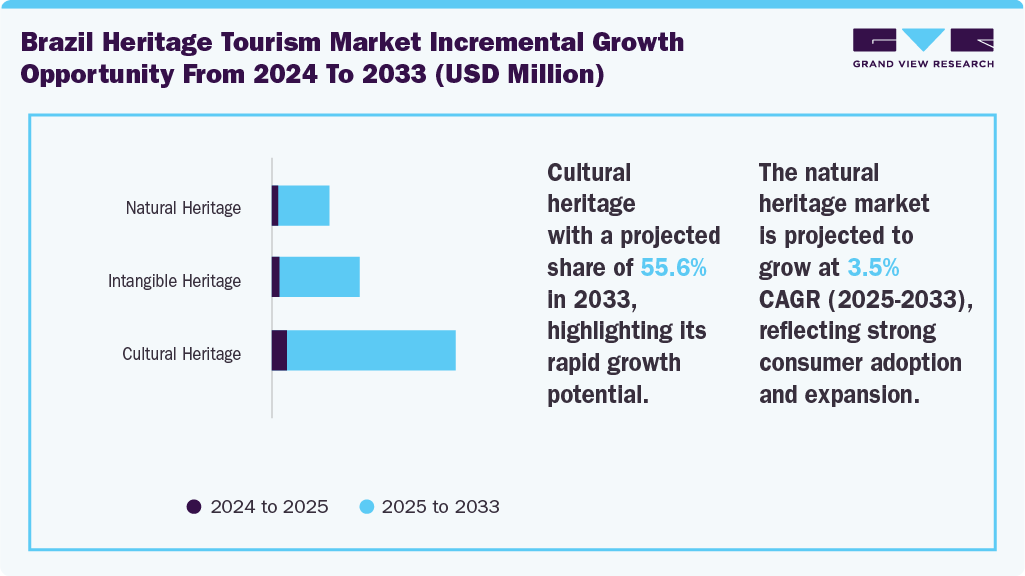
Natural heritage tourism is expected to grow at a CAGR of 3.5% from 2025 to 2033. Natural heritage tourism in Brazil is propelled by the country’s vast ecological diversity, including the Amazon Rainforest, Pantanal wetlands, and Atlantic Forest reserves. Increasing awareness of biodiversity conservation and climate change has heightened interest in nature-based travel experiences. For instance, Paraty and Saco de Mamanguá offer nature lovers a perfect getaway as mountains and oceans surround the place and have rich colonial architecture. Ecotourism initiatives, national park expansions, and improved access to remote areas are making these natural sites more visitor-friendly. International demand for sustainable travel and Brazil’s global reputation for unique ecosystems continue to drive growth.
Age Group Insights
Travelers in the 51-70 age group accounted for a share of 58.7% in the overall Brazil heritage tourism industry in 2024. For the 51-70 age group, Brazil’s heritage tourism appeals through nostalgic connections, historical depth, and slower-paced, culturally enriching experiences. This group values guided tours, architectural landmarks, and traditional performances that offer comfort, learning, and authenticity. They often have higher disposable income and time flexibility, enabling longer stays and premium services. Health-conscious and security-aware, they also prefer well-organized, accessible destinations with reliable amenities.
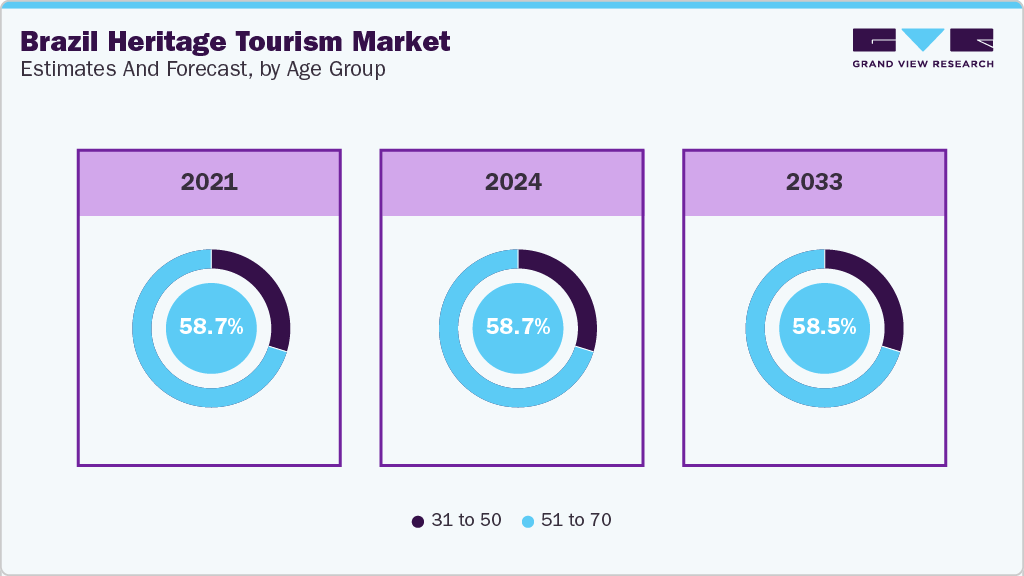
Travelers in the 31-50 age group in Brazil’s heritage tourism industry are expected to grow at a CAGR of 3.7% from 2025 to 2033. The 31-50 age group is drawn to Brazil’s heritage tourism through a mix of cultural curiosity, family-friendly offerings, and experiential travel trends. They seek immersive activities such as local cooking classes, artisan workshops, and heritage site exploration, blended with leisure. Tech-savvy and socially aware, this segment values sustainability and often shares their travels digitally, influencing broader interest. They also favor destinations that combine cultural richness with modern comforts and flexibility.
Booking Mode Insights
Booking through offline mode generated a revenue share of 69.1% in 2024. Offline bookings in Brazil’s heritage tourism market are driven by personal trust, especially among older travelers or those in rural areas who prefer face-to-face interaction with travel agents. Local tour operators, cultural institutions, and community centers play a key role in promoting heritage experiences through printed brochures and word-of-mouth. These channels also cater to group tours and customized itineraries. Physical presence allows for real-time clarification, enhancing traveler confidence and satisfaction.
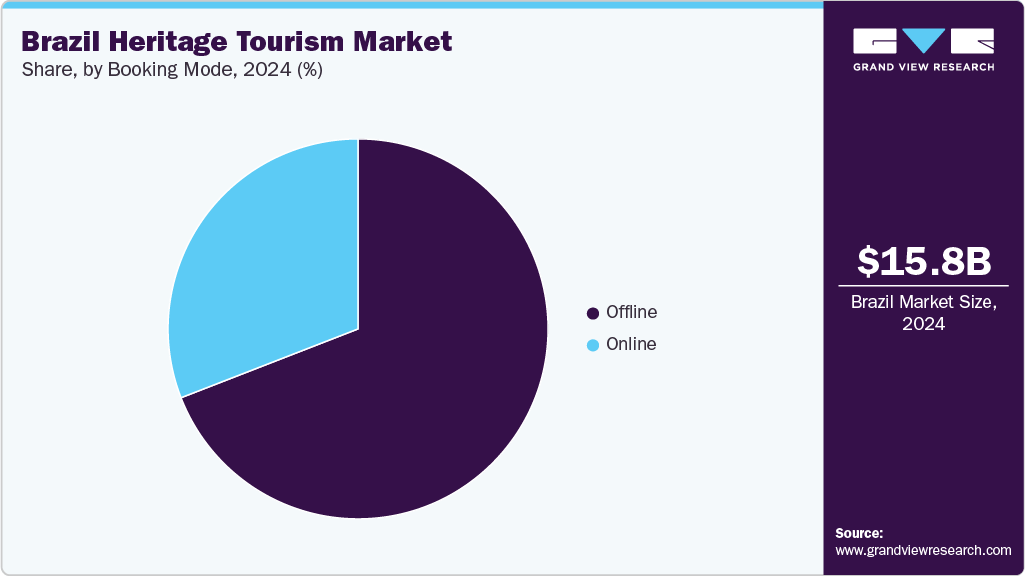
Booking through online mode is expected to grow at a CAGR of 4.2% from 2025 to 2033. Online bookings are fueled by convenience, wider access to destination information, and real-time price comparisons. Younger and tech-savvy travelers increasingly rely on mobile apps, travel platforms, and social media to discover and reserve cultural experiences. Digital marketing, user reviews, and influencer content significantly impact decision-making. Online platforms also enable dynamic packaging of heritage stays, activities, and transport for personalized travel planning.
Key Brazil Heritage Tourism Companies Insights
Key players operating in the Brazil heritage tourism market are undertaking various initiatives to strengthen their presence and increase the reach of their products and services. Strategies such as expansion activities and partnerships are key in propelling the market growth.
Key Brazil Heritage Tourism Companies:
- Agaxtur Viagens
- Paraty Tours
- Ouro Preto Turismo
- Flytour
- Schultz Turismo
- Compass Brazil
- Terra Brasil Turismo
- Brazil Green Travel
- Gregtur Turismo
- Viare Travel
Recent Developments
-
In February 2025, Turismo de Portugal and Embratur (Brazilian Agency for International Promotion of Tourism) signed a formal cooperation agreement with Turismo de Portugal during the 14th Luso‑Brazilian Summit, aiming to establish deeper relations in the field of tourism.
-
In January 2024, CAF and Embratur signed a USD 150,000 technical cooperation agreement in Madrid to boost Afrotourism, aiming to promote sites such as quilombos, samba schools, music festivals, and Afro-Brazilian cultural experiences internationally.
Brazil Heritage Tourism Market Report Scope
|
Report Attribute
|
Details
|
|
Market revenue in 2025
|
USD 16.06 billion
|
|
Revenue forecast in 2033
|
USD 20.36 billion
|
|
Growth rate
|
CAGR of 3.0% from 2025 to 2033
|
|
Actuals
|
2021 – 2024
|
|
Forecast period
|
2025 – 2033
|
|
Quantitative units
|
Revenue in USD million/billion and CAGR from 2025 to 2033
|
|
Report coverage
|
Revenue forecast, company ranking, competitive landscape, growth factors, and trends
|
|
Segments covered
|
Type, age group, and booking mode
|
|
Country scope
|
Brazil
|
|
Key companies profiled
|
Agaxtur Viagens; Paraty Tours; Ouro Preto Turismo; Flytour; Schultz Turismo; Compass Brazil; Terra Brasil Turismo; Brazil Green Travel; Gregtur Turismo; Viare Travel
|
|
Customization
|
Free report customization (equivalent up to 8 analysts working days) with purchase. Addition or alteration to country, regional & segment scope
|
|
Pricing and purchase options
|
Avail customized purchase options to meet your exact research needs. Explore purchase options
|
Brazil Heritage Tourism Market Report Segmentation
This report forecasts revenue growth at the country level and provides an analysis of the latest industry trends and opportunities in each of the sub-segments from 2021 to 2033. For this study, Grand View Research has segmented the Brazil heritage tourism market report based on type, age group, and booking mode:
-
Type Outlook (Revenue, USD Billion, 2021 – 2033)
-
Cultural Heritage
-
Natural Heritage
-
Intangible Heritage
-
-
Age Group Outlook (Revenue, USD Billion, 2021 – 2033)
-
30 and Under
-
31-50
-
51-70
-
70 and Above
-
-
Booking Mode Outlook (Revenue, USD Billion, 2021 – 2033)
Frequently Asked Questions About This Report
b. The Brazil heritage tourism market size was estimated at USD 15.78 billion in 2024 and is expected to reach USD 16.06 billion in 2025.
b. The Brazil heritage tourism market is expected to grow at a compound annual growth rate (CAGR) of 3.0 % from 2025 to 2033 to reach USD 20.36 billion by 2033.
b. Cultural Heritage accounted for a revenue share of 55.6% in 2024, driven by rich colonial history, diverse indigenous traditions, vibrant Afro-Brazilian culture, and UNESCO World Heritage sites.
b. Some key players operating in the Brazil heritage tourism market include Agaxtur Viagens, Paraty Tours, Ouro Preto Turismo, Flytour, Schultz Turismo.
b. Key factors driving market growth in the Brazil heritage tourism market include its rich colonial architecture, diverse indigenous and Afro-Brazilian cultural expressions, and globally recognized UNESCO sites. Government initiatives, cultural festivals, and growing international interest in authentic cultural experiences further boost the sector.
link