
A blockchain-based carbon registry platform for credible climate action in transportation
This section describes the key methods of CATchain-R. First, the system workflow of CATchain-R is presented to illustrate the working mechanism at a conceptual level. Second, a blockchain token-based carbon credibility index is constructed to evaluate the carbon credibility levels of carbon entities. Finally, System Dynamics model is built with a feedback loop diagram for CATchain-R. The detailed technical architecture and consensus rationale of CATchain-R are provided in Supplementary Information (Supplementary Notes 1 and 2, Supplementary Table 1).
Conceptual system workflow
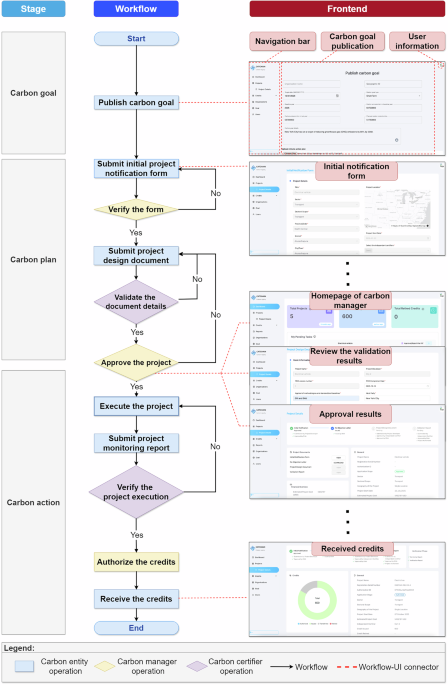
To illustrate the working mechanism of CATchain-R, we present a conceptual system workflow in Fig. 3. It integrates all the carbon registry operations and part of the carbon market functions in order to make a unified blockchain-based carbon registry ecosystem. Compared with existing carbon registries, the workflow of CATchain-R is designed with three features: (i) it records annual goals to support measurable tracking of goal fulfillment; (ii) it decouples project developers from verification by having the registry select auditors, thereby strengthening independence and reducing conflicts of interest. Accordingly, certifiers should be paid by the registry rather than by carbon entities; (iii) it enables full project-lifecycle traceability by immutably storing all transactions and related information for on-demand tracking and verification. Specifically, the workflow comprises seven steps: (1) carbon goal publication, (2) project registration, (3) project validation, (4) project execution, (5) project verification, (6) credit acquisition, and (7) project credit marketing.

The workflow is constructed in compliance with (International Organization for Standardization) ISO 14064-2, ISO 14064-3 and ISO 14065. We briefly present the voluntary carbon market to illustrate the complete ecosystem of carbon registry/market, which will be discussed in further research. Source: authors’ own elaboration.
First, after the user registration, the carbon entity needs to publish its carbon goal, where a carbon entity sets measurable emission reduction goals following international frameworks such as the Science Based Targets initiative (SBTi). For instance, at the start of the carbon reporting year, the carbon entity publishes “carbon goals” containing carbon reduction milestones in the short, medium, or long term.
Second, in support of achieving carbon goals, the carbon entity needs to submit its “carbon plans”, which can be specific carbon offset projects, such as switching to renewable fuels, transitioning to electric vehicles, etc. For instance, the carbon entity can initiate a carbon offset project by submitting project initialization documentation to the registry, including methodology, baselines, and expected reductions following ISO 14064-2.
Third, the carbon manager, acting as the system administrator, needs to review these submissions to ensure alignment with established standards and registry criteria. Then carbon certifiers, as the independent third-party, need to validate the technical rigor of the proposed project based on internationally recognized methodologies such as ISO 14064-3 and ISO 14065. Validation results are stored immutably in CATchain-R to guarantee data integrity and auditability.
Fourth, once validated, the project advances to the execution phase, during which the carbon entity implements the planned activities. The progress and outcomes of project actions are continuously uploaded and timestamped into the blockchain-based carbon registry to ensure real-time traceability, such as financial records, human resources records, etc. At the end of the carbon reporting year, the carbon entity is required to submit its monitoring report to present all monitored data and emission reduction/removals calculations on which credits are issued.
Fifth, carbon certifiers re-examine the project’s actual performance data and produce a formal verification report. This is the key step to guarantee carbon credibility of the outcomes of carbon actions. To better build trust, we employ two primary assessment mechanisms. One is that smart contracts enforce predefined validation rules for objective checks and time-series consistency with prior data. The other is that certifiers (e.g., experienced practitioners and sustainability researchers), who participate as auditing members in CATchain-R, independently evaluate the subjective data and documents. We design multiple verification methods for the certifiers, such as onsite inspection, interviews, document analysis, etc. To enable transparent verification, the carbon certifiers must also disclose all the verification methods, theoretical foundations of the carbon credits calculation, and the certifier’s personal information, etc.
Sixth, once the carbon certifiers’ verification reports are approved by carbon manager, the carbon entity can be rewarded with tokenized carbon credits based on the actual emission reductions and carbon credibility index. Each tokenized carbon credit represents 1 tCO₂e verified reduction and carries a unique serial number for traceability, which can be traded in the carbon market to prevent double counting.
Seventh, the carbon registry can be linked with the carbon market, allowing trade and retirement of tokenized carbon credits. Carbon entities may act as both buyers and sellers of credits, opening the door to a more dynamic marketplace. Once issued, credits can be sold, transferred, or retired. All the types of transactions (e.g., transferring, selling, and buying) take place in CATchain-R to provide for transparency, immutability of transactions, and automatic enforcement of trade rules.
Blockchain token-based carbon credibility index
To provide a quantitative measure of carbon entity performance, CATchain-R calculates the “carbon credibility index”. As shown in Supplementary Table 2, the carbon credibility index is assessed using the carbon credibility evaluation framework including 5 objective and 5 subjective criteria, derived from globally recognized sustainability and carbon reporting frameworks and existing literature32,33,34,35. The objective criteria include carbon reduction rate, timeliness, fulfillment rates of planned projects, completeness of annual carbon goal, and transparency level. The subjective criteria include sustainable innovation and practices, alignment with global standards and goals, community impact, consistency and reliability of reporting, and long-term sustainability and impact. The objective criteria are automatically evaluated based on predefined smart contracts, while the subjective criteria are evaluated by professional experts.
Based on the Hurwicz Criterion principle44, we set two adjustive parameters, α and β, for objective and subjective criteria, respectively. By default, α and β are both set to 0.5, with α and β summing to 1. Therefore, the carbon credibility index can be calculated using Eq. (1):
$$\mathrm{Carbon}\,\mathrm{credibility}\,\mathrm{index}={\rm{\alpha }}* {\sum }_{{\rm{i}}=1}^{5}{{\rm{\omega }}}_{{\rm{i}}}* {{\rm{C}}}_{{\rm{i}}}+{\rm{\beta }}* {\sum }_{{\rm{i}}=6}^{10}{{\rm{\omega }}}_{{\rm{i}}}* {{\rm{C}}}_{{\rm{i}}}$$
(1)
where, \({\omega }_{i}\) and \({C}_{i}\) denote the weight and score of carbon credibility evaluation criterion \(i\) in Supplementary Table 2, respectively. We use Analytic Hierarchy Process (AHP) to determine the weights of the carbon credibility evaluation criterion.
We use AHP to determine the weights of the objective and subjective criteria, respectively. AHP is a straightforward and effective method to collect expert opinions to determine the weights for each of our criteria45. We designed the AHP questionnaire and collected opinions from 15 carbon experts, including 11 university sustainability researchers, three carbon rating-agency practitioners, and one panel member of the United Nations International Resource Panel. Given their extensive research and practical experience, we consider this panel representative for deriving weights for the carbon credibility indicators in our demonstrative case study.
Then the rewarding tokenized carbon credits are calculated based on the carbon credibility index and base tokens using Eqs. (2) and (3), which are made based on the documentation of United Nations Development Programme National Carbon Registry project46. The volumes of the base tokens are equal to the total verified values of all the carbon reduction/removal of all the carbon offset projects by the carbon entity. The carbon credibility index works as an indicator of how many tokenized carbon credits can be rewarded to the carbon entity, while the remaining tokens of the base tokens will be withheld into a shared buffer account by the registry to ensure future reversals or non-performance. Therefore, total base tokens from verified reductions are split into rewarded vs buffered portions according to the carbon credibility index; buffered tokenized carbon credits cannot be sold and serve as risk coverage. Notably, \(j\) refers to the \({j}_{{th}}\) carbon offset project by the carbon entity.
$$\mathrm{Rewarding}\,\mathrm{tokenized}\,\mathrm{carbon}\,\mathrm{credits}=\mathrm{Base}\,\mathrm{tokens}* \mathrm{Carbon}\,\mathrm{credibility}\,\mathrm{index}$$
(2)
$$\begin{array}{lll}{\mathrm{Base}}\,{\mathrm{tokens}}&=&\sum\limits_{{\rm{j}}=1}^{{\rm{N}}}\,{\text{Estimated baseline removals}}_{{\rm{j}}}\\&&-\mathrm{Estimated}\,\mathrm{project}\,{\mathrm{emission}}_{{\rm{j}}}\\&&-\mathrm{Estimated}\,\mathrm{leakage}\,{\mathrm{emission}}_{{\rm{j}}}\end{array}$$
(3)
Another token-related activity in CATchain-R is the token-based carbon credibility certification (some registries also call credit retirement). For simplicity purposes, the details for the token-based carbon credibility certification can be checked in Supplementary Note 3 and Supplementary Fig. 2.
System dynamics model for carbon credibility evaluation
The System Dynamics (SD) approach is used to simulate the behaviors of carbon commitments and study how the climate pathways are driven by the carbon credibility level. Figure 4 illustrates the system structure of the blockchain-based carbon credibility evaluation and identifies how the criteria of the credibility index influence carbon commitments and carbon emission reductions. The Vensim PLE software was used in the development of the diagram. This software is among a variety of packages (Stella, i-think, Powersim, and DYNAMO) capable of high-level simulation in SD. The system structure contains stocks, flows, and auxiliary variables. Stock variable characterize the state of the system and generate information that influences subsequent decisions. The quantities of these stocks are defined by the respective inflows and outflows. Meanwhile, auxiliary variables account for exogenous variables and feedback mechanisms amongst the stocks and flows of the system.

Rectangles represent stocks, blue arrows indicate causal influences and flow directions, and cloud icons denote exogenous sources/sinks; CO₂ refers to carbon dioxide. The diagram summarizes how objective (timeliness, transparency, fulfillment) and subjective factors feed the credibility index, which shapes incentives, reduction rates, and the evolution of activities and emissions, together with carbon commitment and price. Source: authors’ own elaboration.
Starting from the bottom of Fig. 4, carbon prices can be used to spur climate action alongside the rising awareness of environmental sustainability47. In the feedback diagram, the carbon price is driven by incentivizing organizations to make carbon commitments. When the carbon price for each ton of carbon emissions rises, it means that one token can be sold at a higher price. With a carbon commitment, the carbon entity will make carbon goals, plans, and actions. Once these climate actions have been completed, the blockchain-based carbon credibility evaluation can be conducted using subjective and objective criteria. The evaluation delivers a carbon credibility index that determines how many tokenized carbon credits that organizations receive. The blockchain-based carbon registry facilitates the determination of the credibility index based on an organization’s commitments and actual delivery. This creates feedback in the system structure. Incentivizing current climate action practices positively impacts carbon commitments and consequently drives the creation of future actionable plans to reduce GHG emissions. The availability of the carbon credibility criteria motivates stakeholders to improve specific performance metrics, knowing that the score will dictate the token incentives they will receive. The evaluation process consequently improves the quality, implementation, and effectiveness of these plans in reducing carbon emissions.
link